Harlem
Taxi DriverHarlem is one of the places where Travis Bickle’s night work, racialized perception of the city, and growing attraction to armed danger converge. He drives through it as both a taxi driver and a self-appointed observer, expecting the streets to test him; the encounters he describes do not always fulfill that expectation. Spanish Harlem, meanwhile, is the setting of a grocery-store robbery he witnesses, linking the wider neighborhood to a sudden, immediate confrontation with violence.
Night Work and Urban Setting
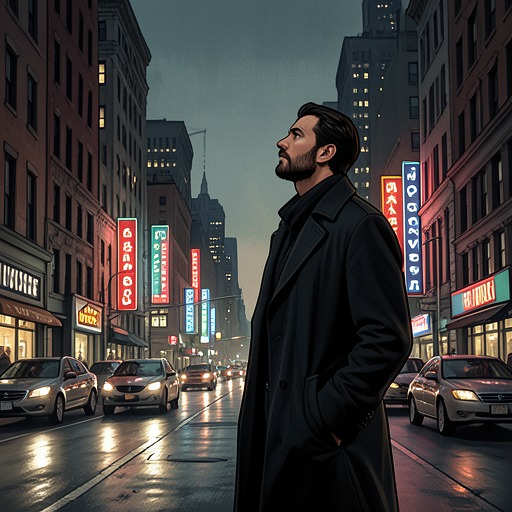
Harlem enters Travis’s account as a place few drivers would choose to serve at night. When he explains why taxi work suits him, he points to the South Bronx and Harlem as routes that other people would avoid. The remark makes the neighborhood part of the job’s difficult geography: night driving takes him into areas he presents as undesirable, while also letting him move through the city and observe it from the cab.
His description of New York City is shaped by contempt and broad social categories. He reduces its morning street life to drunks, Black people, and prostitutes, a hostile framing that exposes more about his way of seeing than it establishes about the neighborhood itself. Harlem becomes especially charged in this outlook because he associates its streets with racial difference and possible danger.
Patrols and Expectations
As his preoccupation with weapons deepens, Travis begins deliberately taking fares through the Black neighborhoods of the north, around 128th Street and Amsterdam Avenue. He says he wants to know what might happen if he were forced to use his guns, and to make a private dream visible to himself. The route is therefore more than an extension of ordinary taxi work: he turns the city into a place where he can anticipate a violent test without yet having to initiate one.
He describes driving through Harlem and along Seventh Avenue amid petty criminals, steering around wine bottles in the road and passing crowded stretches of Lenox Avenue. His movement continues south through the Lower East Side to Tompkins Square and nearby streets, among adolescents and solitary people. The sequence gives his night patrol a physical progression through different city districts, while his description of moving through darkness casts the journey as an attempt to make himself feel real through the presence of his weapons.
Yet the encounters in Harlem do not match the confrontation he imagines. Travis reports that people are polite, tip him, and keep to themselves; he finds no trouble. That contrast matters: the neighborhood’s danger is, at this point, largely the expectation he brings to it. The streets provide a setting for his readiness and fantasy, but the residents he encounters do not confirm the violent scenario he is seeking.
Spanish Harlem and the Grocery Robbery
Spanish Harlem is the setting of a separate, specific nighttime encounter. Travis goes to a grocery store there to buy food while the streets are relatively empty. The owner, Melio, works while listening to salsa and welcomes company at night, particularly company he knows to be armed. The shop is an ordinary place of late-night business before the scene shifts abruptly toward threat.
While Travis is in an aisle at the back, he hears a man speaking harshly to Melio. At the counter he sees a young Black man, visibly high, threatening the shopkeeper with a gun and demanding money. The robber jumps in cheap black sneakers; Melio appears frozen with fear. Travis is still unnoticed, and he judges that the young man may be attempting his first serious robbery. The evidence establishes the location, the threat, and the positions of the men at the moment Travis approaches; it does not, in this scene, establish the robbery’s outcome.
Narrative Significance
Harlem’s importance lies partly in the difference between the place Travis seeks and the place his account actually shows. He enters its streets armed and alert, hoping for a circumstance that will give his weapons and sense of danger a purpose. The reported politeness of residents frustrates that expectation, while the grocery robbery in Spanish Harlem supplies a concrete instance of armed threat without making every journey through the area a confrontation.
The routes also show how the city organizes Travis’s attention. He moves from work into deliberate patrol, reading neighborhoods as stages on which his private plans might become action. Harlem is thus not merely a backdrop to taxi driving: it is a recurring point in the geography of his imagined danger, set against the ordinary exchanges of fares, tips, and late-night shopping.